Three Equipment Formats for Home KTV
Component systems pair separate microphones, an effects processor, and speakers for the deepest adjustability at the cost of professional wiring. Plug-in hosts integrate reverb DSP and wireless reception into one box over HDMI ARC, deploying in ten minutes but limited by TV speakers. All-in-one machines bundle amplifier, DSP, speakers, and wireless microphones into a wheeled cart.
| Format | Rated power | Deployment | Typical room |
|---|---|---|---|
| Component set | 100-300 W | Professional | Dedicated theater |
| Plug-in host | Depends on TV | Ten minutes | Living room, rentals |
| All-in-one | 40-120 W | Instant | Parties, outdoor |
Microphones: Dynamic, Condenser, and UHF Wireless
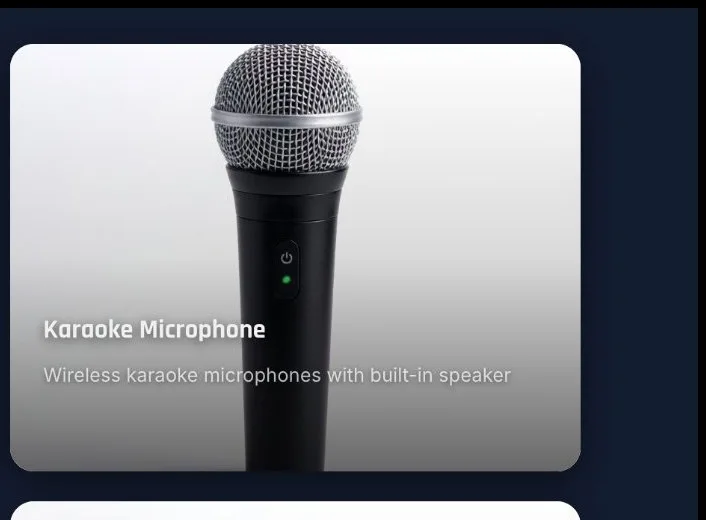
Microphones are decided by capsule and band. Dynamic capsules at -54 to -50 dBV/Pa tolerate 130 dB SPL and reject room noise for close singing. Condensers at -45 to -38 dBV/Pa deliver detail but pick up reflections and invite feedback in reverberant homes. UHF at 470-960 MHz beats VHF and 2.4 GHz in antenna efficiency, wall penetration, and co-site channels, at the cost of per-region frequency planning. The K90 pairs a dynamic cardioid capsule with adjustable UHF channels.
Reverb, DSP, and Effects Tuning
Much of the karaoke sound comes from DSP, not the microphone. The chain runs four stages: input gain with an 80-120 Hz high-pass cutting rumble, compression at 2:1 to 4:1 smoothing amateur volume swings, reverb with 10-40 ms pre-delay and RT60 of 1.2-2.5 s kept short in hard rooms, and EQ dipping 200-400 Hz mud while lifting 2-4 kHz presence. For OEM buyers, what matters is open DSP parameters, a PC tuning tool, and preset capacity.
Speaker Power, SPL, and Distortion Control
Power is the most misread parameter, with RMS versus PMPO differing by 5-10x. SPL follows sensitivity and power, with typical drivers at 85-92 dB per watt per meter, so 50-80 W RMS stereo covers 95 dB peaks in a 20 square meter room. Distortion matters more: keep THD below 1 percent at rated power, since voices roughen past 3 percent, and set limiters to compress smoothly near clipping rather than hard-clip.
All-in-One vs. Component Systems
All-in-one BOM concentrates in the cabinet, amplifier, and battery, with tooling amortized quickly at volume, which suits e-commerce. Component systems spread cost across an effects unit, amplifier, and two speakers, allowing staged investment but adding service risk from feedback, ground loops, and impedance matching that often exceeds the hardware gap. The criterion is whether users will tune anything: e-commerce returns run lower on all-in-one machines.
OEM Configurations for Cross-Border E-Commerce
On cross-border platforms, all-in-one share keeps rising because of return rates, not sound. For karaoke equipment OEM projects, RFQ precision decides quote accuracy: lock the wireless band and destination radio approvals, microphone count and co-site capacity, battery specs shaping UN38.3 and freight, and add-ons and packaging drop-test standards. Party speaker customization increasingly demands light sync, telescopic handles and wheels, IPX ratings, and instrument inputs, each changing tooling and certification cost.
Why Choose Aurora Sound
Aurora Sound is a Shenzhen source audio factory for karaoke and party equipment OEM/ODM. Engineering covers UHF frequency planning and co-site testing, self-tuned DSP reverb with client presets, integrated thermal and reliability design, and compliance-first band selection per destination. Tooling, PCBA, and assembly happen in one park, engineering changes respond in days, and programs start from full ID development or platform-based configuration.