What Problem Does an Under-Pillow Speaker Solve
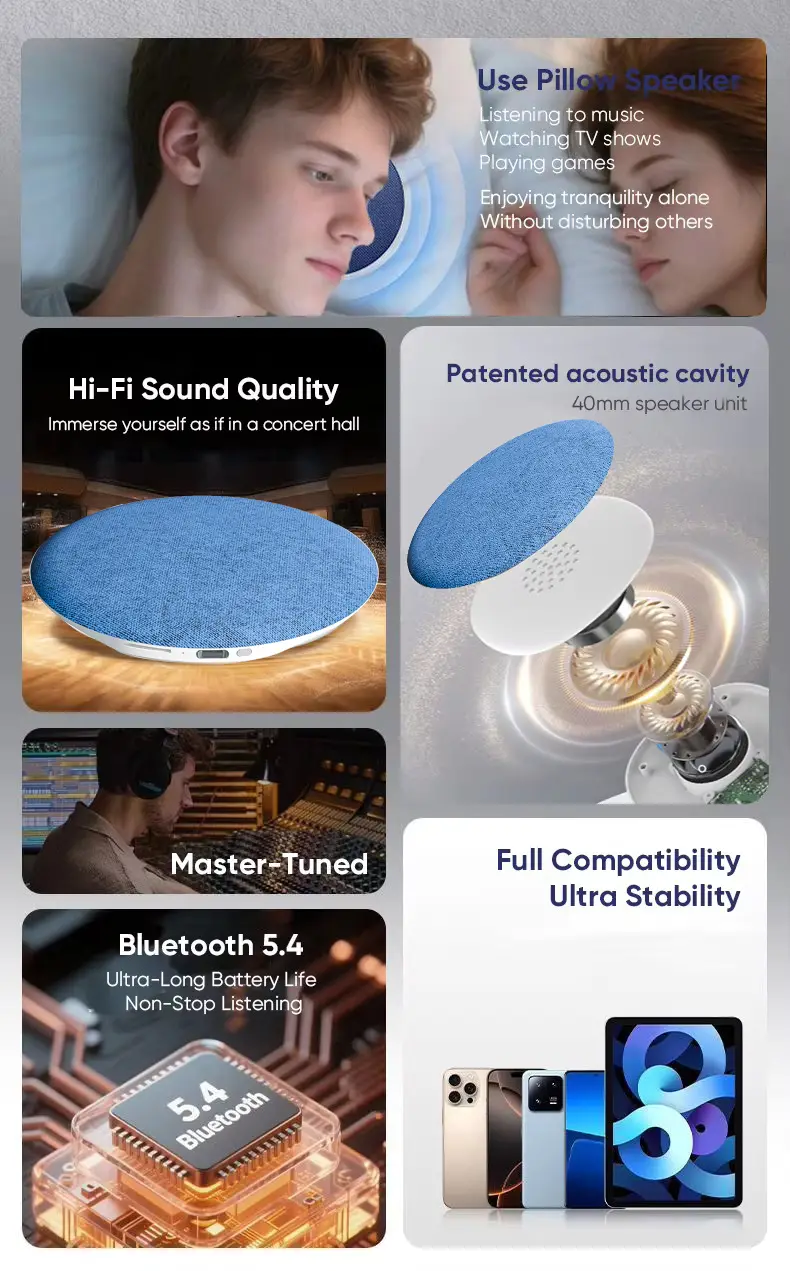
This is a category defined by scenario, not technology. It solves a concrete conflict: some people need sound to fall asleep, but open speakers disturb partners and earbuds create canal pressure while blocking alarms. Demand splits into sleep-onset difficulty, tinnitus masking, and shared households needing private listening. Design goals invert a normal Bluetooth speaker: low-frequency conduction efficiency, narrow directivity, and a deliberately low SPL ceiling.
Conduction Physics: Why Low Frequencies Pass Through a Pillow
The core physics is frequency versus medium attenuation: short-wavelength highs are absorbed quickly by porous pillow fill, while a 100 Hz wave stretches 3.4 m and diffracts through with little loss.
| Frequency | Wavelength in air | Relative loss through cotton fill |
|---|---|---|
| 100 Hz | 3.4 m | Low, 3-6 dB |
| 500 Hz | 0.68 m | Moderate, 8-12 dB |
| 2 kHz | 0.17 m | High, 15-20 dB |
| 8 kHz | 4 cm | Very high, above 25 dB |
Privacy Engineering: Not Disturbing the Person Beside You
Privacy is engineered along three paths. Frequency trimming cuts the 500 Hz to 4 kHz speech intelligibility band, leaving output that is audible but unintelligible. Near-field attenuation fires the surface downward into the bed frame with isolating layers on top, yielding 15-25 dB between the ear position and 50 cm above the pillow. A 75-85 dB SPL ceiling with compression tames sudden passages.
Timers, Volume Curves, and Sleep Tracking
Timers and volume curves create the biggest experience differences and easiest firmware differentiation. Hard power-off clicks, so use a 3-5 second fade with 30, 60, 90 minute, and whole-night tiers. Volume logic mirrors sleep: constant for 15 minutes, then decaying to 30-40 percent to prevent early waking. Sleep tracking uses an accelerometer for movement, wearables for sleep stages, or a microphone for local events, and copy must avoid therapeutic claims.
Materials, Safety, and Certifications
Products touch skin and bedding for whole nights, so requirements exceed ordinary speakers. Contact surfaces should use food-grade or medical silicone at Shore A 30-50, with removable washable fabric preferred. An overnight device needs battery protection against overcharge, overdischarge, and shorts, surface temperature below 45 degrees Celsius, and IEC 62368-1 compliance. Export requires CE, RoHS, and REACH for the EU, FCC for the US, UN38.3 and IEC 62133 for the battery, and IPX4 against splashes.
OEM Opportunities in Home Audio
Under-pillow speakers sit in a low-competition, high-margin position where the technical barrier is low and scenario understanding is what general speaker factories lack. Differentiation paths include tinnitus masking, infant soothing, and privacy variants, content preloads with sleep apps, and cushion or bedside-clip form factors reusing one platform. OEM tooling is modest at 60,000-120,000 RMB, and validation should anchor to objective response and distortion ceilings.
Why Choose Aurora Sound
Aurora Sound is a Shenzhen source factory covering under-pillow speakers, sleep audio, portable Bluetooth speakers, and open-ear headphones for OEM/ODM. Experience concentrates in low-frequency conduction and vibration isolation, with HY05 for under-pillow use and HY03 as a compact bedside format. Acoustic tuning, prototyping, and reliability testing happen in-house, and buyers can benchmark existing platforms before defining changes.