Why Wireless Lavalier Microphones Became a Content Essential
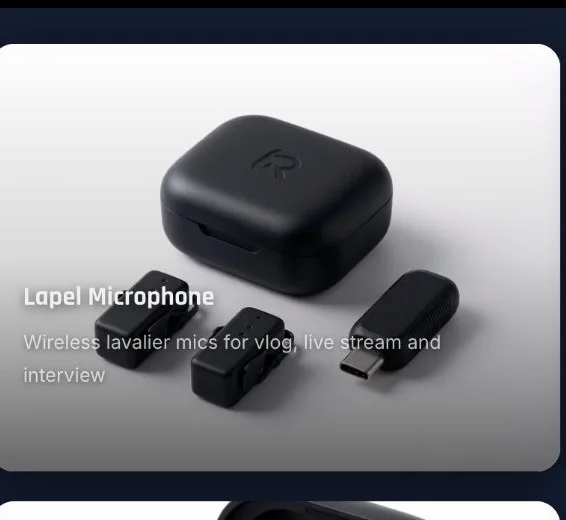
Short video, live commerce, and online courses turned audio capture into an everyday workflow. A wireless lavalier microphone fixes the capsule 15-25 cm from the mouth, securing a stable near-field speech level while suppressing room reflections. Growth came from the 3.5 mm jack's removal, falling MEMS and DSP pricing, and charging cases that absorbed range anxiety.
Transmission: 2.4 GHz Digital vs. UHF Analog
The wireless link divides the class, so look at where users shoot before cost.
| Dimension | 2.4 GHz digital | UHF analog, 600-900 MHz |
|---|---|---|
| End-to-end latency | 12-25 ms | 3-8 ms |
| Line-of-sight range | 30-80 m | 50-150 m |
| Interference handling | Adaptive hopping and error correction | Manual channels, stable in clean spectrum |
| Compliance | One global SKU | Regional band plans, multiple SKUs |
Noise Reduction: ENC, DSP, and Wind Noise
ENC acts only on the uplink voice and has nothing to do with ANC, so spec sheets must separate the two. A dual-mic design with the primary capsule toward the mouth delivers 15-25 dB of steady-state reduction at the best value, while single-mic subtraction handles only stationary noise. Wind noise needs physics: a furry windscreen attenuates 10-20 dB at 5 m/s wind and algorithms add 5-10 dB more.
Compatibility: iPhone, Android, and Camera Interfaces
Compatibility drives returns, so the interface matrix and a tested device list belong in the specification.
| Interface | Target devices | Engineering notes |
|---|---|---|
| Lightning | Older iPhones | MFi licensing affects cost and lead time |
| USB-C | iPhone 15 onward, Android | USB Audio Class 2.0, best compatibility |
| 3.5 mm TRS | Cameras, recorders, mixers | Level matching, switchable output pads |
| 3.5 mm TRRS | Legacy phones, laptops | OMTP vs. CTIA wiring, adapter needed |
Battery and Charging Case Design
Battery figures need stated test conditions; the convention is noise reduction off at 25 degrees Celsius and 50 percent volume. Transmitters carry 60-120 mAh for 5-9 hours, receivers 200-400 mAh, and cases 800-1500 mAh for 2-3 recharges and 20-30 hours total, with bypass charging for live streaming. The design effort is structural: pogo pins qualified for 5,000-10,000 insertions, Hall switches for lid-open wake, and magnetic alignment within 0.3 mm.
B2B Procurement: Key OEM/ODM Specifications
A quote breaks into PCBA, mechanical parts, battery, packaging, and certification and tooling amortization. White label programs run 500-1,000 sets with no tooling in 2-4 weeks, light customization runs 1,000-3,000 sets with 30,000-80,000 RMB of tooling over 6-10 weeks, and deep customization with a new housing starts at 3,000-5,000 sets and 80,000-150,000 RMB over 12-20 weeks. Certification adds FCC ID, CE-RED, and BQB listing, 4-8 weeks combined. A lavalier microphone factory rather than a trading company decides whether you can audit test data directly.
Why Choose Aurora Sound
Aurora Sound is a Shenzhen audio source factory focused on OEM/ODM with no retail brand of its own, so it never competes with customers for channels. Capability concentrates on in-house tooling development, in-factory test benches for electroacoustic parameters, wireless links, and battery safety, and certification experience across major export markets. Standard projects sample in 2-4 weeks and deliver 4-6 weeks after DVT and PVT sign-off.